


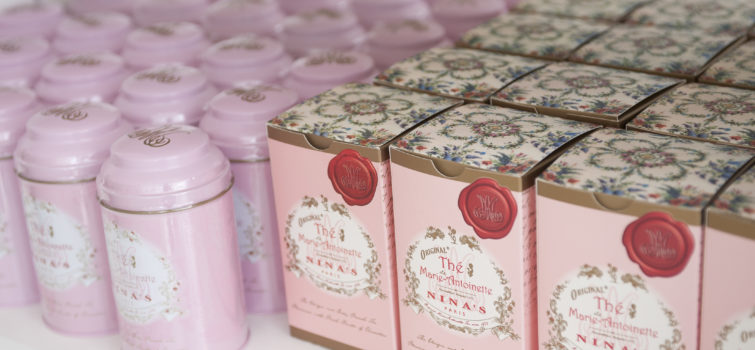
Founded in 1672 by Pierre Diaz, “La Distillerie Frères” was the first perfumery to distill lavender and rose essences to scent gloves. During the 18th century, its essence of rose was especially appreciated by Queen Marie-Antoinette, who oversaw the purchase of the product herself. In exclusive partnership with the King’s vegetable Garden in Versailles, Nina’s Marie-Antoinette perpetuates this unique know-how and great legacy. Flavored with the King’s vegetable Garden’s apples and roses, the iconic Marie Antoinette tea unveils the art of royal tasting. The boutique’s intimate and feminine decor charms us as much as this house’s history … A royal getaway in all simplicity!
ALEXANDRA SOJFER HOUSE
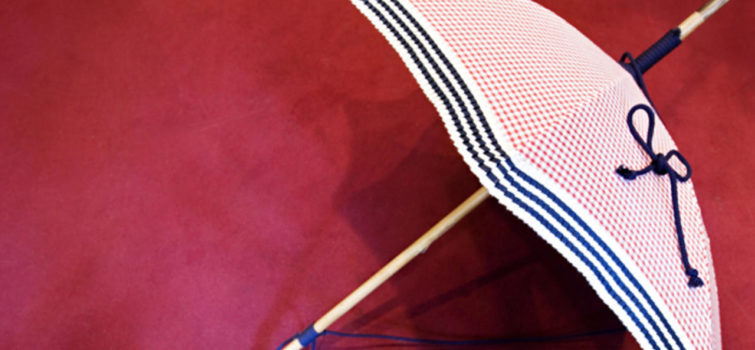
The Alexandra Sojfer House designs exceptional umbrellas that require unique know-how. Handcrafted in the brand’s workshops, all raw materials are chosen with the greatest care. Each model is then sewn, piece by piece, in the workshops, both for series and unique numbered pieces. A rare craftsmanship transmitted over generations that inscribes the Alexandra Sojfer house in the great French tradition of luxury.
History of a French hand-fan maker

The Parisian and couture spirit of Duvelleroy
Once upon a time in 1827, Jean-Pierre Duvelleroy dreamt of creating couture hand-held fans for fashionable Parisian women. Following a lavish ball in which fans were a required accessory for a particular dance, Jean-Pierre’s dream came true. His elegant fans became the talk of the town and his company Duvelleroy was born.
No details were spared in the French art de vivre of Duvelleroy fans. This became even more clear in 1851 at the Universal Exhibition when the young fan-maker won first prize at the Crystal Palace in London with a hand-made fan for Queen Victoria. From then on, the finesse and craftsmanship of the fans were recognized for their unique French savoir-faire. Duvelleroy won many gold medals, including the Légion d’Honneur, the Greatest Order of Merit in France. That began Duvelleroy’s prestigious position as the supplier of hand-made fans to various courts, beginning with Queen Victoria. It was also Duvelleroy who created Eugénie de Montijo’s fan for her wedding with Napoleon III as well as gifts for the spouses of statesmen during their visits to France. Among them was the Empress of Austria, the Queen of Sweden, the Queen of Denmark and the Queen of Bulgaria. The Parisian who’s who and style mavens would also be found gracing the streets holding a Duvelleroy fan in their hands.
The Belle Époque period that followed allowed Jean-Pierre’s heir Georges Duvelleroy to flourish creatively, with artists including Billotey, Abbéma and Maurice Leloir taking part in the creations. From this Art Nouveau style which took into consideration a more organic and curvy aesthetic, two house emblems were born. The “Balloon” fan was named after the aerial shape of its leaf and the daisy as a signature stamped on each rivet. By the end of the 19th century, Duvelleroy had further entered the art world with collaborations by famed illustrators Paul Iribe, Gendrot and Gicar. Their advertising work even led to hand-fans for luxury greats including the Ritz. In a word, the Duvelleroy Maison was thriving!
As for the fans themselves, what were these elegant accessories used for, exactly? More than to offer relief from the heat, handheld fans were used among a certain class of ladies as a form of discreet communication. In 1711, Joseph Addison wrote in The Spectator: “Women are armed with fans as Men with Swords and sometimes do more execution with them.” While illustrated instructions on how to use a fan already existed, the London branch of Duvelleroy published its own version of fan gestures used to send messages including “I love you” by drawing the fan across the cheek or “follow me” which involved carrying the fan in the right hand in front of the face. This fit right in with the maison’s playful spirit.
To complement the hand-fans, Duvelleroy also created select accessories required by their clientele for a life of refinement. These included an array of elegant evening purses and innovative binoculars, all led by Georges Duvelleroy’s forward-thinking direction. This all changed after World War I when this way of life ended and fabric hand-fans lost their luster. Meanwhile, ostrich fans increased in popularity during the roaring 20s and it was the Duvelleroy Maison that made the white ostrich feather fan worn by the Queen of Egypt Farida Zulfikar for her wedding with King Farouk in 1938. After fan maker and painter Madeleine Boisset and Georges Duvelleroy’s daughter took over the maison, adhering to the savoir-faire passed down from each generation, it was their evening bags that kept the business active.
In 1940, Jules-Charles Maignan acquired the maison and along with skilled fan-maker Boisset by his side, the business continued to thrive after World War II. As one of the few fan-makers still in business, their main activity focused on selling and restoring antique fans. Archives from the Duvelleroy Maison were passed on to grand-son Michel Maignan in 1981 with the wish by Jules-Charles, “I give it to you so that you can make something out of it.” Consequently, the patrimony was presented in retrospective exhibits around the world, from the Galliera Museum in 1886 to England’s Duvelleroy Exhibition: King of Fans, Fan-maker to Kings, in 1995.
Was this the end of the Duvelleroy Maison? Not if Michel Maignan could help it. In 2010 he joined forces with Eloïse Gilles and Raphaëlle Le Baud, two young women passionate about brand heritage and artisanship. Their reawakened maison brought back to life the French fan-making savoir-faire while respecting the tastes of modern times. Each new creation encapsulates the Parisian and couture spirit of Duvelleroy. While more luxurious fans are often composed of silk, feathers, and ebony the prêt-à-porter series combines cotton, wood, and sometimes even leather. From bright color palettes to more muted hues, the selection of hand-held fans at Duvelleroy’s boutique in Paris’s left bank is endless. Customization of all the fans is also available by adding initials in gold letters.
The latest Duvelleroy collection named Menagerie, recalls the house’s tradition of painting their clients’ pets on the hand-held fans. This playful heritage is animated in a collaboration with multidisciplinary artist MV de Bascher who gives life to Dédé the dog, Fifi the hamster, and Léon the cat. These furry creatures are designed in a vintage etching style with a nod to Japanese pop. This historic house also released a book, Treasures of the Parisian Couture Hand-Fan as well as wall lamps in the shape of fans, and feather headdresses to complement the hand-fans.
By Kasia Dietz
THE CHOCOLATE ALCHEMIST
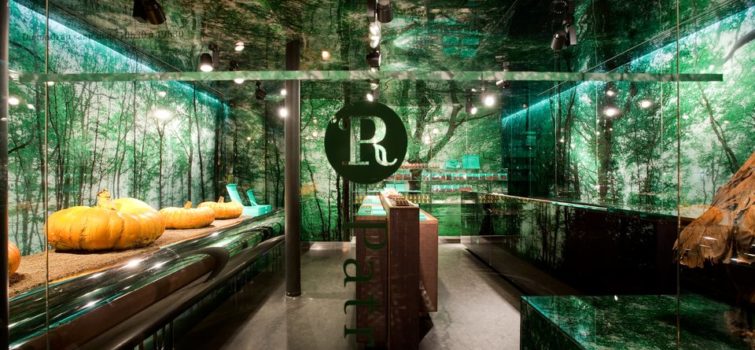
Patrick Roger is a famous yet atypical chocolate maker. Chocolate World Cup Winner in 1994, “Meilleur Ouvrier de France” in 2000, he is also a sculptor. Its green shops display its works and contain treasures that will satisfy the most demanding gourmets. Dive into the universe of this genius creator!
BALUCHON HOUSE
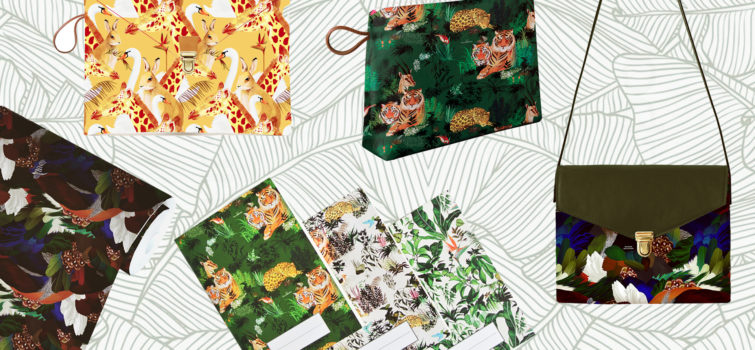
Inspired by the naturally rich and preserved territory of the Haute-Marne in which they live, the founders of Maison Baluchon have chosen to create a brand reflecting their direct environment. The company designs custom-made fashion accessories and mobilizes local know-how from seamstresses and craftsmen to conceive its accessories (design, printing, leather work…).
CHEZ ANTOINETTE POISSON

This is the story of three friends, passionate about Decorative Arts and the restoration of historical interiors and wallpapers, who fell in love with a craft technique that had fallen into oblivion: dominotery. In 2012, they decided to join forces to revive this 18th-century French know-how and founded the company “A Paris chez Antoinette Poisson”. This name is a tribute to the Marquise de Pompadour, born Jeanne-Antoinette Poisson, amateur of arts and wallpapers. This trio of enthusiasts enable us to discover the charm of the intimate interior decorations of the eighteenth century.